

If your desk, inbox, and brain feel equally cluttered, this post is for you — 10 organizational tips for teachers so that you can feel peaceful, confident, and ready each day!
Hi, I’m Jenni, a mentor and coach to new teachers. I give new teachers and future teachers (like you) tips and strategies to navigate your first few years of teaching! Sign up here for monthly guides that support you through the beginning of your career! Now let’s get into it!
When everything feels urgent, nothing feels peaceful — and that’s not sustainable. And the truth is, peace in teaching rarely comes from having more time — it comes from having clearer systems.
You see, no one tells you that chaos is NOT a personal failure… It’s really a systems problem. I’m giving you my top tip, my #1 first! The part of my systems that keeps me together! Trust me, the other 9 organizational tips for teachers are just as good if you’re looking for a little peace and clarity.
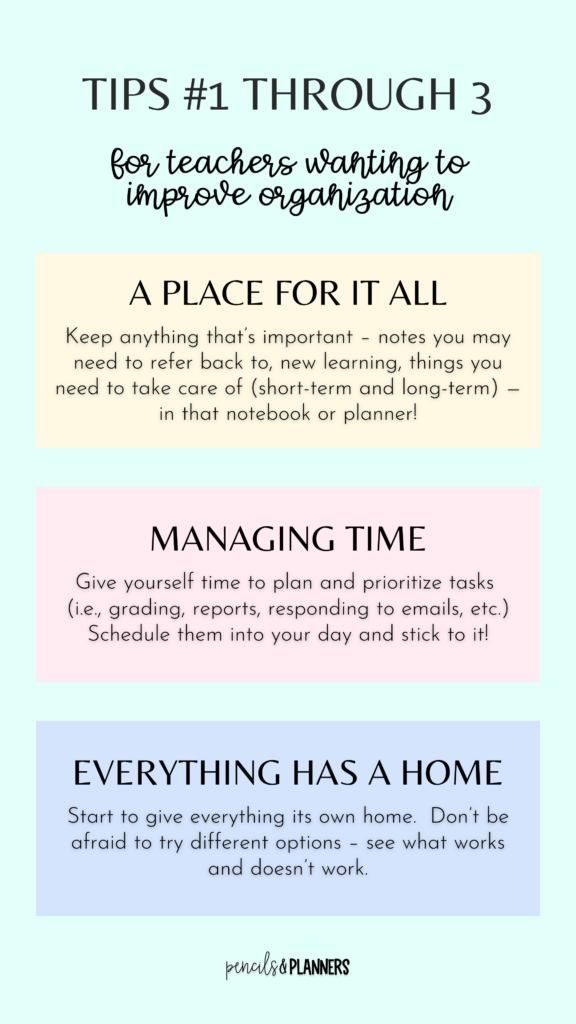
#1. Pick a place for notes
And I mean ALL notes – PD notes, meeting minutes, to dos. Pick a planner or notebook that you LOVE (i.e., quality, size, color/pattern, etc.). I prefer notebooks (Five-Star college ruled notebooks to be exact- these colors are my favorite!). Keep anything that’s important – notes to refer back to, new learning, things to take care of (short-term and long-term) — in that notebook! When a new idea pops up, write it down in your notebook! This helps get it out of your brain and on paper. Whether it’s details about data that’s due this Friday or a classroom theme for next year – it goes in my notebook! When I need it, I’ll know where to look. From this “hub” of mine – I can add important dates to my calendar, follow-up on any action items (or to dos), and refresh my memory after conversations and meetings.
This is MY FAVORITE of all the organizational tips for teachers – — the one that has made the biggest difference in my productivity, efficiency, and sanity!
If you’re constantly searching for things, second-guessing yourself, or staying late to ‘catch up,’ you’re not alone—and you’re not broken.
#2. Managing time as a teacher
There’s so much to do in a day, a week, a unit – lesson planning, differentiating, parent outreach, answer emails, attend meetings. Give yourself time to plan and more importantly prioritize tasks (i.e., grading, reports, responding to emails, etc.) Schedule them into your day and stick to it! Be realistic when determining how much you want to (and how much you can) get done in a given day. Don’t be upset if it takes longer than expected, especially those first few years!
ALWAYS be sure you take your lunch to eat and socialize with your team. This break can easily be replaced with work tasks because you feel like there’s so much to do (there is a lot to do) — but hold this boundary strong! Take that lunch! Your brain and your body need it!
#3. Everything should have a home
As you learn about the intricacies that make your classroom YOURS – start to give everything a home. Your work bag needs a spot after you unpack each morning. Where can you always find your scissors? Where will you keep highly used supplies like pencils, post-its, copy paper, etc.? Don’t be afraid to try different homes for items over time — give one a shot and see what works and doesn’t work. There are plenty of options out there from space efficient items to more aesthetically pleasing options. (Think paper trays versus file folders, binders versus notebooks, shelving versus bins, and so on.
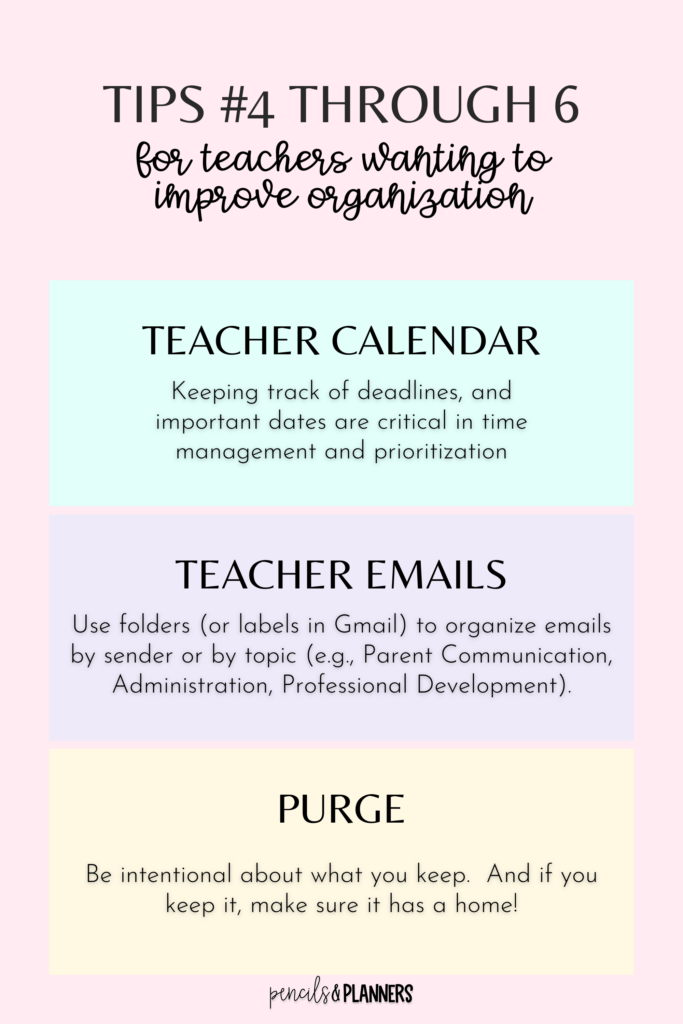
#4. Use a teacher calendar planner
Keeping track of deadlines and important dates are critical in time management and prioritization. What’s great about having a place for dates is that you can make it as comprehensive as you want! Whether you throw in family and friend birthdays alongside parent-teacher conferences and phone calls is entirely up to you! Having a visual layout of what’s happening can really help target quieter, slower periods of time when you can pace out bigger projects or tasks while lightening the workload on really busy school weeks!
#5. Managing teacher emails
Whether you’re receiving emails from administrators, parents, or educational companies – an overwhelming inbox can really stunt progress and productivity. Delete emails that you don’t need to read. Do this when you open your inbox. Once you’ve cleared out those emails, you can focus on those that need attention. Use folders (or labels in Gmail) to organize emails by sender or by topic (e.g., Parent Communication, Administration, Professional Development). Need to come back to an email? I recommend leaving it unread so you remember to come back to it!
Clutter steals your energy before the day even begins. You’re halfway through! Start following these organizational tips for teachers and you will start to feel the weight and burden lifted!
#6. Purge it if you can
I’m a paper and pencil kinda girl… the physical act of taking notes helps me focus and retain the information. It also means I print a lot and I have lots of books and notebooks. We also receive a lot of memos, manuals, and lists. Be intentional about what you keep. Using printed tutorials or teacher’s guide materials? Once you’ve done your planning or completed the unit, file those papers if you will use them again or toss them if it’s done. Transfer important dates and meetings in your calendar.
PRO TIP: Use the location field to add in a Zoom/Teams/Meet link and use the description field to add details, reminders, questions you want to ask, or an agenda.
REALLLLY don’t want paper but feel compelled to keep documents in their original form? Consider a portable, simple scanner (like this one) to scan important docs into your drive and then toss the paper! I personally use Genius Scan on my phone because I only keep a few, SUPER important documents.
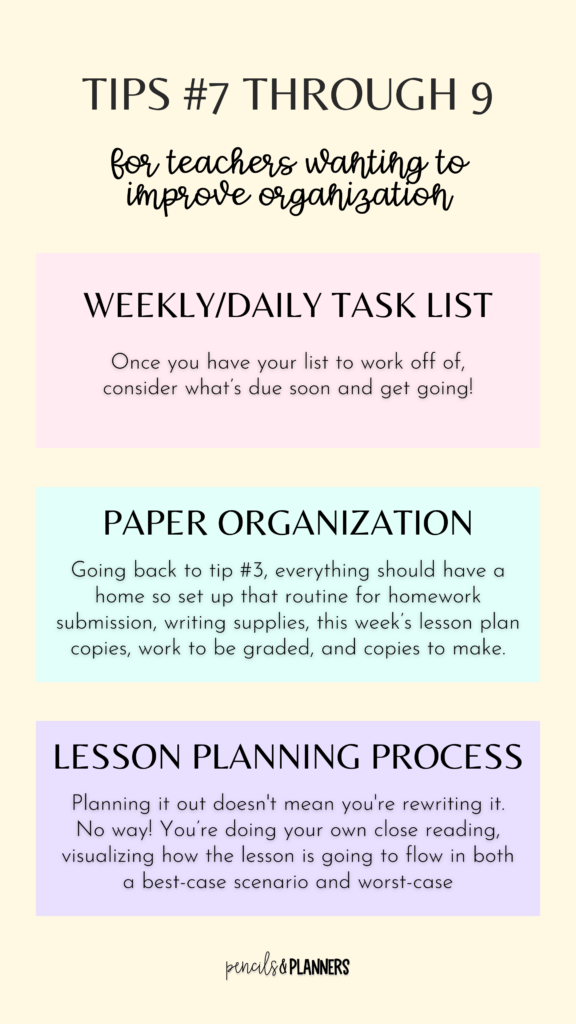
#7. Keep a weekly or daily teacher task list
Explore with this to find what works best for you! I tend to keep a weekly list and on days when I feel overwhelmed, I transfer the items I HAVE to get done onto a short list (usually a post-it). I always have “pie-in-the-sky” ideas I want to make happen — those lists I keep in my notebook (tip #1). Once you have your list to work off of, consider what’s due soon and get going!
It’s not just the mental load teachers handle daily but also the paper load. Organization isn’t about being perfect — it’s about creating enough calm to think clearly and teach well.
#8. Paper Organization
You’ll be collecting student work and having students access different writing materials. Going back to tip #3 at the start of these organizational tips for teachers — everything should have a home! Set up routines for homework submission, writing supplies, this week’s lesson plan copies, work to be graded, and copies to make. This helps avoid piles of doom that we later can’t find exactly what I need.
#9. Lesson Planning Process
HAVE ONE! I’ll repeat it again… Have a lesson planning process! I KNOW it’s easier in the short-term to not sit down ahead of time to read through and “plan it out.” But planning it out doesn’t mean you’re rewriting the lessons. No way! You’re doing your own close reading, visualizing how the lesson is going to flow in both a best-case scenario and worst-case. Jot notes, list questions that you have and questions you want to ask your students, highlight what you’ll need for the lesson, and note what you can do to help all your students (what might you need to change?). You’ll feel more prepared for potential questions and will have everything ready for your class (i.e., anchor charts, handouts, scaffolds).
You won’t need to do this forever but I do recommend it for the first couple of years on a grade. After about 2-3 years, you’ve become familiar with trends in questions from students, aware of typical roadblocks and misconceptions in understanding, and have likely tried a couple of strategies. This can take time, it’s a true process. SO, don’t try to do this for every single subject at first. You’ll burn yourself out and resent the process (trust me, I know from experience). Choose one subject (I recommend Reading) and focus those units when planning – break it down and internalize. For the other subjects, you can read through manuals ahead of time to familiarize yourself with the lesson expectations. Next year, you pick a new subject to focus on and do the deeper work.
I also do not recommend planning day-by-day but rather you should plan for at least a week ahead. While you are teaching this week’s lessons (that were already planned), you can slowly plan next week’s. You should always walk into Monday morning, ready to go!
#10. Before you leave, QUICKLY organize your work space
At the end of any given day, you might have tons of homework and classwork to grade, recent unit data to analyze, post-its, and absence letters – all strewn across your desk. Before you leave, set aside a couple of minutes to minimize what stays on your desk. If it’s staying on your desk it should be in your plan to address the following day. Whatever WILL be on your desk should be neatly organized. Personally, I organize my materials based on what I need to do first – top priority is at the top of the pile for tomorrow’s tasks.
More organizational tips for teachers:
- 4 Classroom Systems Every Teacher Needs
- 5 Teacher Organization Systems That Save Me Time and Restored My Sanity
- How to Be Organized as a Teacher
Organization is the system no one talks about in teacher prep programs. There is no overnight solution. And it can take trial and error. Talk to colleagues, visit other rooms — try new ideas to find what works for you! Once you find it — be consistent! Having systems in place will leave you feeling calmer, clearer, and more confident!
If you’re looking for additional support and guidance getting organized or even throughout your first few years of teaching, let’s chat! Throw time on my calendar. During this chat, we’ll share a little about ourselves and then focus on your questions! No cost, just collaboration in a safe space!

But before you go, drop it in the comments 👇🏼 – what do you want to organize?