
Student teaching is the most important of your teaching curricula. It serves as a hands-on experience that fulfills your teaching certification. Every textbook you’ve read, and every plan you’ve practiced writing can now be implemented! During your practicum, you’ll observe, plan, prepare, and reflect. You’ll develop lesson plans and tweak them during and after instruction. While in your mentor teacher’s classroom, you’ll see classroom management and will begin to cultivate a preference for your own style. You might be nervous, and that’s okay. Sometimes you need a little student teacher help! Just remember you’ve got this! And you’ll be successful!
During student teaching, you will grow through the three levels:
-
- the observer
-
- the student, and finally…
-
- the teacher.
But first, I want to share one more key message: Give yourself grace. At first glance, this list may be lengthy, BUT remember, you don’t have to know everything or do everything. When you start feeling overwhelmed, remind yourself to take it easy – take it one thing at a time! AND BE YOU! There’s no one like you, and that’s the best part!
You got this; I mean it!
Before we start…
If you’re new here, hello! You’re reading part 2 of a 4-part student teacher help blog series! Check out the first part of the series here: No More Stress: Learn All About How to Prepare for Student Teaching! In the first blog post, I’ll set you up with everything you need to consider before you start your student teaching experience!

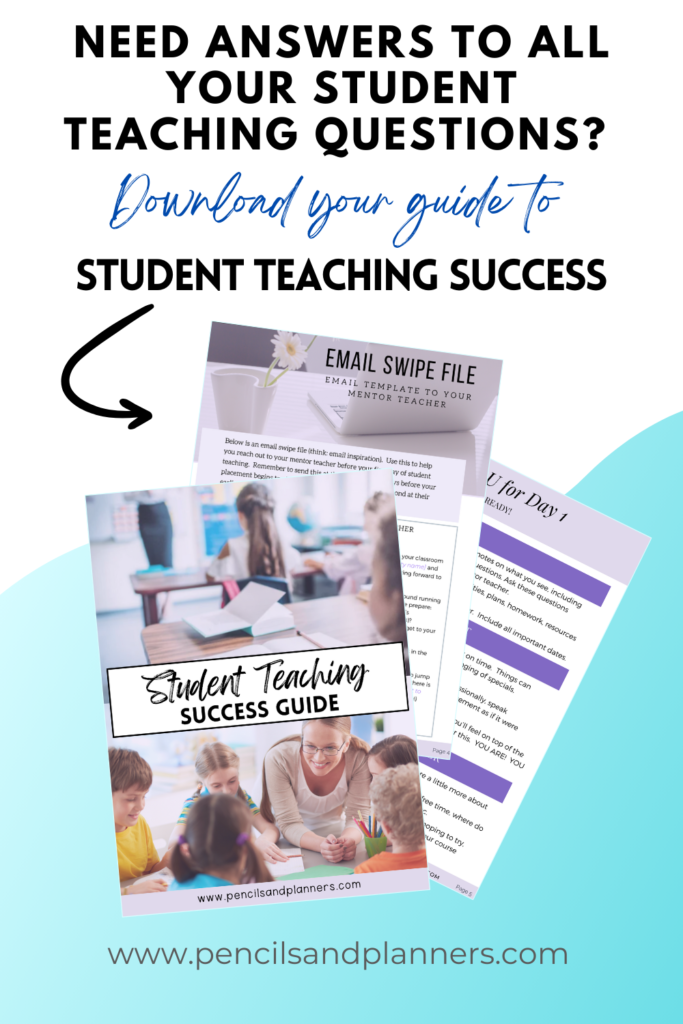
If you’re looking for a printable guide as you prepare for student teaching, click here to download your copy of the Student Teaching Success Guide!

Student Teaching Placement
LEVEL ONE: THE OBSERVER
#1 – Clean up social media.
Scrub each of your social media accounts. Switch to private settings where possible.
#2 – Enjoy the experience.
Be excited. Ride the waves. Don’t do this alone if you don’t want to.
#3 – Make good impressions.
Greet anyone and everyone.
#4 – Befriend office staff.
Office staff are the gatekeepers to the school. They’re also incredibly hardworking and often a major backbone for the school. Acknowledge them, respect them, and genuinely get to know them!
#5 – Get a copy of your building and district handbook.
Review building, district, staff, and student handbooks. You want to be on the same page as everyone else.
Halfway There…
#6 – Collaborate as much as you can, however you can.
Grade teams often work together – ask to join grade-level meetings. Ask questions about every decision or action. Share ideas.
#7 – Show initiative.
Show interest. Don’t wait if you know you can help.
#8 – Take photos. Take notes.
Gather as much info as you can. Later, the notes and photos will be helpful to refer to when you begin setting up your own room.
#9 – Keep a next year notebook.
You will have ah-ha moments… moments where you see something you like and 100% want to bring to your classroom. Keep a list or a section of your notebook that will be your “next year” ideas.
#10 – Avoid the drama and gossip.
It’s unfortunate that every job or workplace has drama and gossip. Try your best to stay away from it, it never goes well.

Advice for Student Teachers
LEVEL TWO: THE STUDENT
#1 – Find your person.
Find someone you can trust, someone that you can grow from and grow with. Find a teacher who is a role model for you – someone you hope to be like. This might be your mentor teacher, but it might not be, and that’s okay!
#2 – Organization is key.
There’s to keep track of when teaching – lesson plans, personal deadlines, college course deadlines, and job tasks you may have. Keep yourself organized with a master calendar (pro tip: color code your life buckets). And use templates when possible to streamline tasks (e.g., lesson plan templates, course assignments, etc.).
#3 – Find your OWN groove.
You don’t have to teach how your mentor teacher does. It may take a little bit to find your groove and your style, but it’ll come!
#4 – Work hard.
Treat your student teaching experience as if it’s your job.
#5 – Take care of yourself.
Ask for help, take a break, and prioritize.
Still With Me? Love it! Let’s Go!
#6 – Be proactive.
Ask your mentor teacher to try a variety of teaching methods. You’re trying to develop your own teaching style; this is a chance to do so with support!
#7 – Observe anyone and anything.
Observe as many teachers as you can – don’t be afraid to go outside of your grade level or even outside the scope of classroom teaching. This will show you a variety of teaching techniques – from good teaching to not-so-good teaching looks like.
#8 – Respect your cooperating teacher’s time.
We know teachers have many responsibilities inside and outside a school/classroom. Respect your mentor teacher’s time and establish expectations that consider their schedule.
#9 – Adjust your schedule to work with your mentor teacher.
Some teachers arrive at school earlier than the day’s start time while others stay after. Both have the same purpose – to prepare for the upcoming day. This is a great opportunity to see what goes into preparing for your lessons and students.
There’s More But It’s Worth It…
#10 – Don’t Reinvent the Wheel.
Pinterest classrooms… we know what I’m talking about. You might want to start off with a super cutesy, creative room and adorable activities. Remember, there is a lot to juggle and learn during student teaching and your first years of teaching in your own room. Repeat this to yourself often – not everything needs to be cute. Not every lesson has to be a brand-new idea, game, or project. Don’t reinvent the wheel!
#11 – Get to know your students.
Rapport and trust take effort and can make or break our class dynamics. Get to know students academically and personally.
#12 – Build Relationships.
Remember, if students consider you more as a friend than their teacher, you will struggle with being seen as the authority figure you are meant to be. Not all students will like you, and that’s okay. It’s normal. Give respect but demand respect.
Almost Done!
#13 – Work the room.
Stay on your feet and alert for student questions and checks for understanding.
#14 – Take risks and experiment!
Your mentor teacher and their classroom are intended to give you hands-on, practical experiences. Use these opportunities to try new things and take risks, knowing that nothing will be THAT detrimental.
#15 – Make mistakes.
Mistakes are great. We learn from them. And they can be fixed.
#16 – Give students choices.
Whether it’s picking their own independent reading books, partners for group work, or topics for writing – giving students choices encourages better engagement and helps students buy-in to the lesson or activity.
#17 – Learn how to differentiate in the moment.
Making adjustments for students when needed is important. These small changes might impact the whole class, individual students, or specific groups of students like English Language Learners or Special Education students. The goal is two-fold. First, it’s to ensure the student feels successful in accomplishing the task. Second, you want to ensure the students understand the completed work.
#18 – Practice reflection.
Reflect independently and with your mentor teacher. Write questions and pointers down. Share the notebook or document with your mentor teacher for additional feedback and tips!

Student Teaching Goals
LEVEL THREE: THE TEACHER
#1 – Celebrate diversity.
Every student should have a voice in the classroom – celebrate diversity in your classroom through content and activities.
#2 – Focus on curriculum, not fluff.
Focus on the objectives – what is the goal for the lesson or project? Certainly, these learning experiences can be fun and cutesy, but be sure to keep the main thing the main thing (i.e., the objective of the lesson).
#3 – Be flexible.
Students thrive when they know that flexibility is an option. Rigidity can cause anxiety and stress. Expectations can still be clear, with flexibility sprinkled in where needed.
#4 – Allow students to set and track their own goals.
Have students track their own learning goals to motivate and engage them in your lesson.
Finish Strong…
#5 – Get students out of their seats.
Movement is key to learning. Therefore, have students get up and move at least once each period.
#6 – Look for teachable moments.
Teachable moments can happen at any time. Use these moments to fill in knowledge gaps, build relationships, and/or reflect.
#7 – Overwhelmed is okay.
Being overwhelmed is incredibly normal, especially in the first couple of weeks. Be honest with your mentor teacher. If your college supervisor and program do not have a gradual release timeline, talk to your mentor teacher about working on one together. Take it day by day.
#8 – Remember your why.
At some point, you’ll be overwhelmed or frustrated and tired. You’ll wonder if this is worth it. Take a moment and think back to why you wanted to be a teacher in the first place. Write your reason down. Keep it close. Put it somewhere you can see it every day. The clouds will clear, and it will get better!
Now, before you go…
Save this blog post and come back to it as you navigate through these growing stages in your student teaching journey! Use each stage as a small checklist. Try a few, or try them all! Looking for additional guidance and support? Book a free 20-minute session with me to talk about your upcoming or current student teaching experience; click here.
Here are some additional reads for student teacher help you may be interested in:
And don’t forget to download your Student Teacher Success Guide to hit the ground running on Day 1!

2 Responses